By Jon Sutz
March 8, 2026
In late 2025, based on an unsolicited proposal I submitted, I was commissioned by the Committee to Unleash Prosperity, a free-market think tank in Washington, DC, to research and design the infographics in Section 2 on this page. I thank them for enabling me to dig into this issue, and for publishing an earlier version of my infographics here. To back up the assertions in my infographics, however, I wanted to write a plain-language yet comprehensive presentation of the evidence. This page is the result. You can see a slimmed-down version on Substack here.
Update, May 12, 2026: I was interviewed on “The Schilling Show” (Charlottesville, Virginia talk radio show) about this report. Listen here (9 minutes).
Update March 19, 2026: I was interviewed on “The Joe Thomas In The Morning Show” (Staunton, VA talk radio show) about this report. Listen here (13 minutes).
“A lie told once remains a lie. But a lie told a thousand times becomes the truth.”
– Joseph Goebbels, Nazi propaganda minister
Contents
(1) Introduction and overview
(2) A citizen’s briefer on tax rates
(3) Is the claim, “billionaires pay a lower tax rate than average Americans,” true? No. It is demonstrably false. Here’s the proof.
(4) Unfortunately, due to a lack of public-facing push-back, most Americans now believe some variant of this lie
(5) The most influential peddlers of the lie – and how to contact them
(6) Source data
6.1: A sampling of the debunkings of these lies
6.2: The 2017 Tax Cuts & Jobs Act reduced the tax rate of millions of low-income Americans to 0% – or less
6.3: Links to key IRS and government agency pages containing the source data that debunks this lie
(7) Responses from peddlers of this lie
(8) Afterword: My view on the urgent need to use evidence-based means to combat the lies that are ripping America apart
(1) Introduction and overview
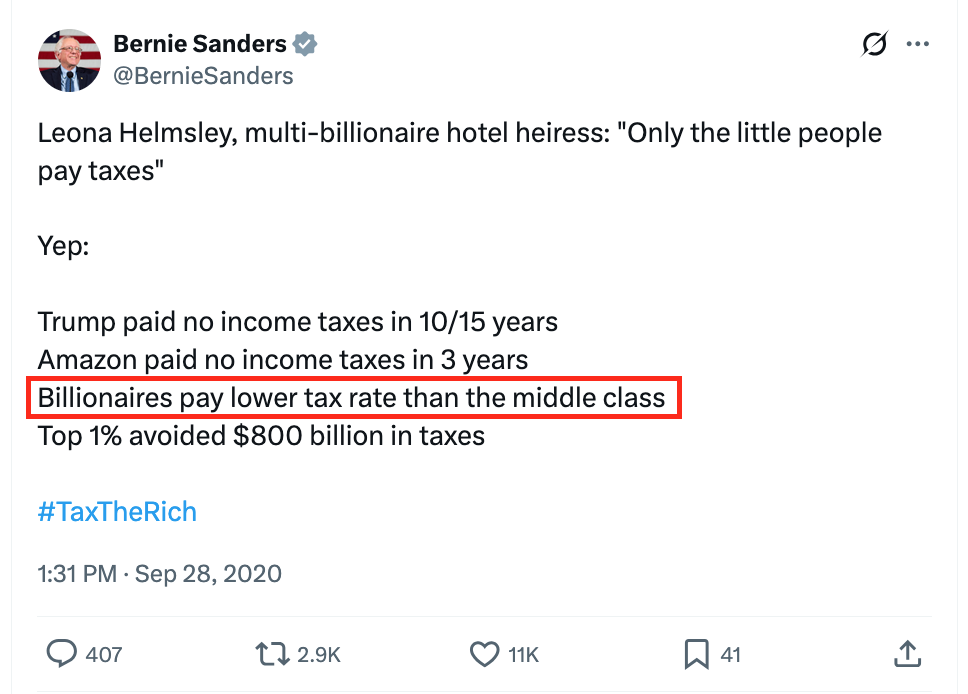
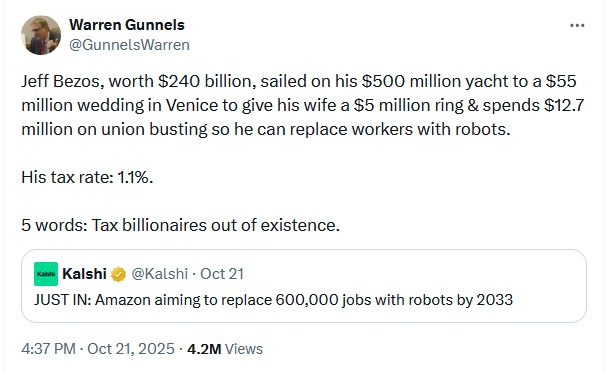
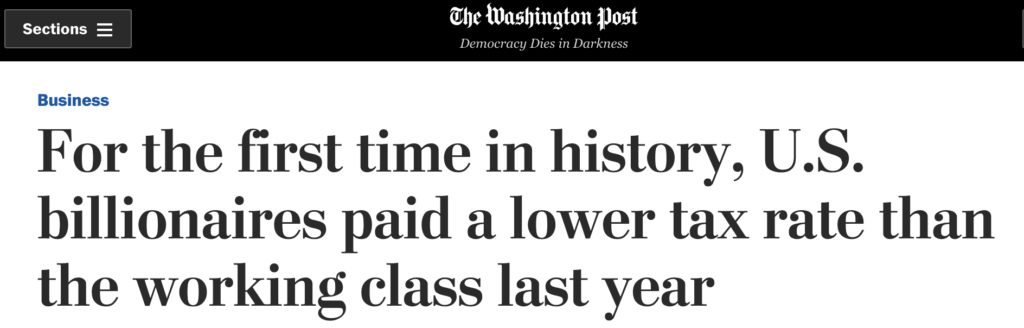
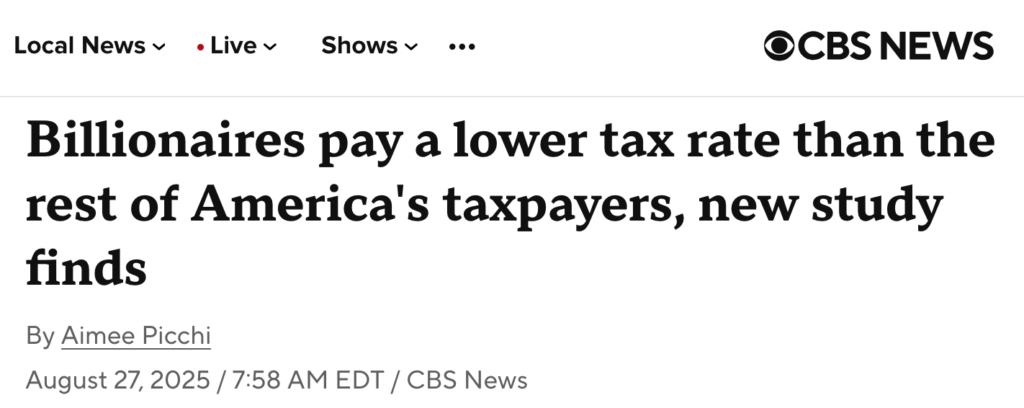
Over the past several years, a growing number of influential figures in politics, journalism, academia, and entertainment have publicly claimed that “billionaires pay a lower tax rate than average Americans.” Below are some examples (click images to go to the actual items). See more examples in Section 5.
And from a senior adviser to Sen. Sanders…
But is this claim true? Do “billionaires really pay a lower tax rate than average Americans”?
No. The truth is that billionaires provably pay far higher tax rates, and an astronomically higher portion of their earned incomes in taxes, than average Americans.
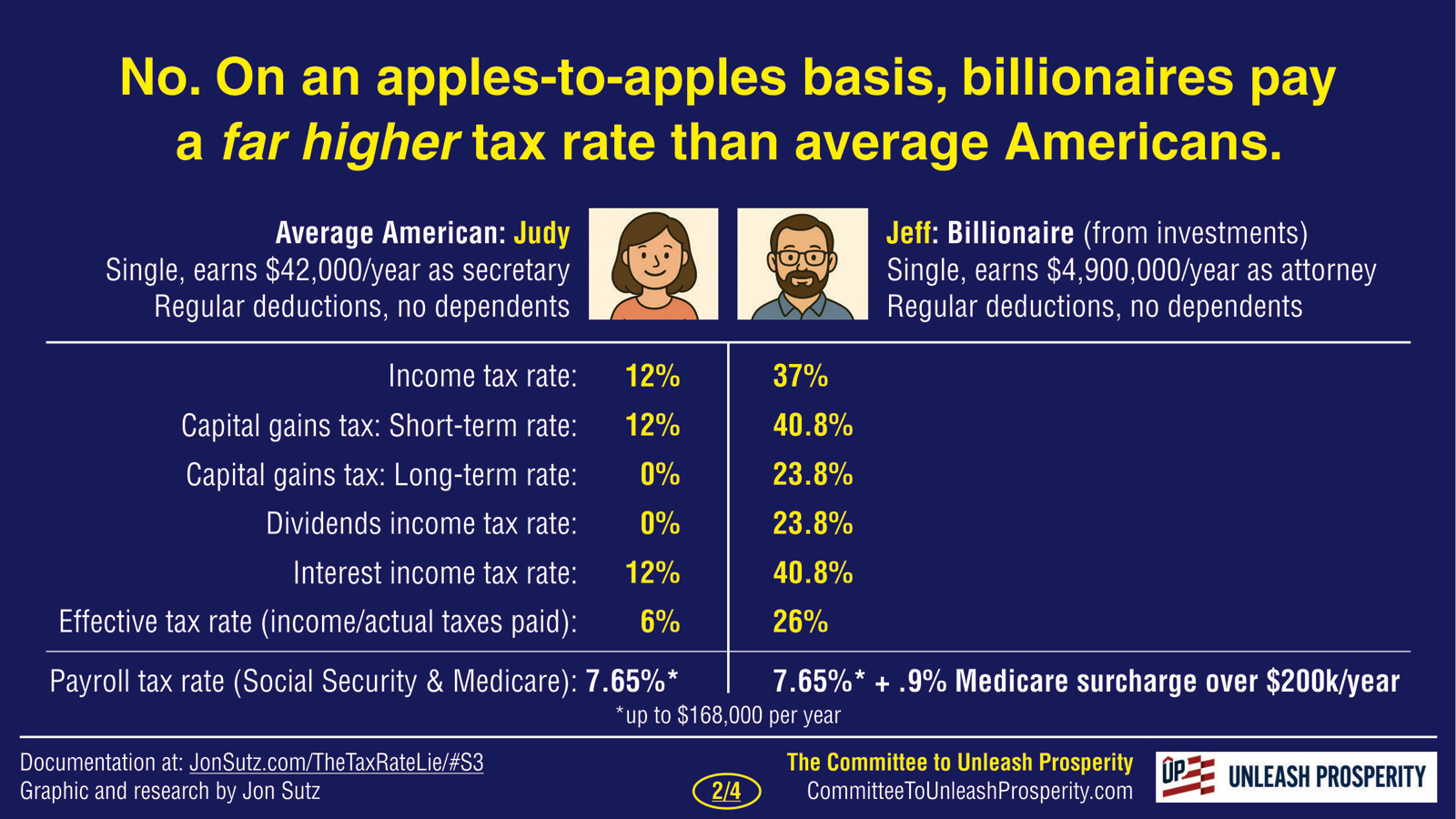
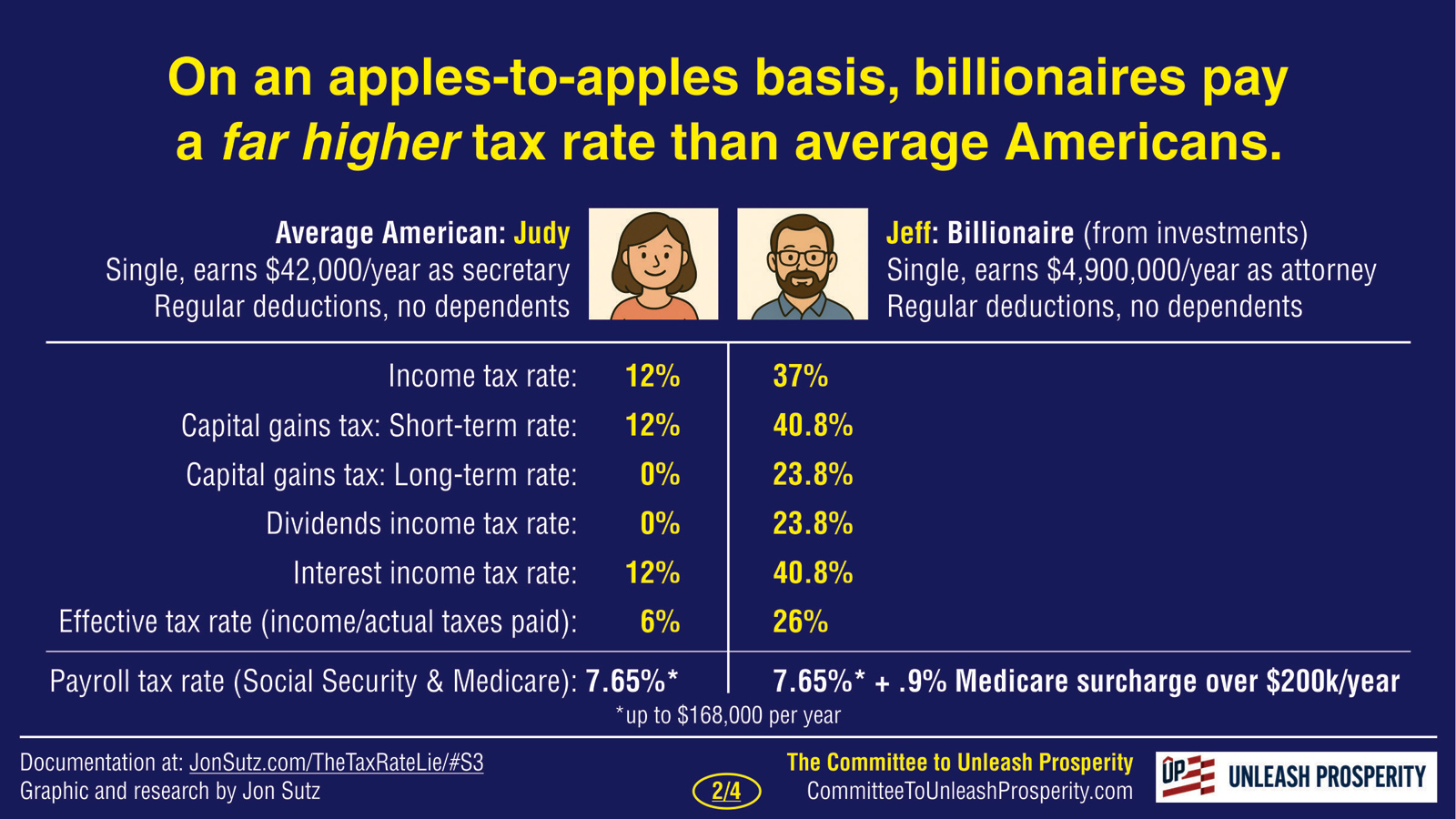
These three infographics lay out the basics, and this page contains the proof of every one of the assertions they contain:

So why would people and organizations with such high influence, who are assumed to have an accurate understanding of our tax system, peddle such an easily-provable lie about it?
Only the peddlers of this lie can answer that question.
One can reasonably speculate, however, that they do it to achieve several unspoken objectives:
- To capitalize on the fact that most of America’s schools no longer require students to demonstrate math, financial or civic literacy in order to graduate: Despite spending more, per-student, on education than any major nation in the world, America’s functional, economic, civic and historical literacy have steadily fallen — while acceptance of upside-down versions of essential facts, have skyrocketed. Americans’ math literacy, in particular, has nosedived. All of these facts make the average American much more vulnerable to be tricked into believing demonstrably false claims about basic issues, by emotional, media-savvy influencers in politics, Hollywood and academia.Here, for example, is what’s happened to young Americans’ math literacy, during a time of skyrocketing spending on our “educational” system; this betrayal has now spread throughout our culture, to the point where most US adults now struggle with basic math tasks:

- To create the public perception that our entire US tax system is corrupt, and rigged to take money from poor and middle-class Americans, in order to shower unearned wealth on the already-rich: Look at the quotes in Section 5, by US presidents, members of Congress, and scholars — they all know the reality, and yet, their words are designed to incite hate, envy and resentment, based on this lie.
- To incite widespread cultural hatred against those who created and lead America’s most spectacularly successful companies, who are rewarded according to formulas established by their boards of directors, based on their performance.
The purpose of this report is to expose the reality, in simple, plain-language terms — and to show the evidence every step of the way.

(2) A citizen’s briefer on tax rates
The first question we must answer, in regards to the lie, “billionaires pay a lower tax rate than average Americans,” is this:
On the federal level, what tax rates are applied to both an average American, and a billionaire?
The answer is, they both are subjected to three main types of taxes at the federal level: (1) Income taxes, (2) Capital gains taxes and (3) Payroll taxes. Here is a summary of each:
(1) Income taxes: These are the taxes applied to the money you earn for the labor you provide to your employer, or clients, such as wages, salaries, bonuses, tips, and other cash income. Within this category, there are two types of income taxes:
(a) Wage income: If you work for a company, whether full-time or part-time, you are taxed on how much you are paid, and this is usually deducted from your paychecks
(b) Miscellaneous income: If you are an independent contractor, or a gig worker, you are required to pay quarterly estimated taxes, according to how much you earn.
(2) Capital gains taxes: These are taxes you pay if you sell something you bought for a higher price than what you paid for it. Common types of things that are subjected to gains taxes are stocks, rental property and other assets, such as a classic car that increased in value between the time you bought it, and when you sold it. Within the capital gains tax structure, there are two general categories that apply to all taxpayers:
(a) Short-term capital gains: Profits that are realized on assets that were bought and sold within the current tax year (example: profits from stocks that day-traders buy and sell within days, weeks or months)
(b) Long-term capital gains: Profits that are realized on assets that were held for one year or more (example: one’s home)
(3) Payroll taxes: These are taxes you pay to fund two social programs:
(a) Social Security: This program provides retirement, disability, and survivor benefits (briefer here)
(b) Medicare: This program is health insurance for people 65 and older, as well as for those with certain disabilities (briefer here)
For all taxpayers:
- Short-term capital gains are taxed at a higher rate than long-term capital gains
- All capital gains taxes are paid during the tax year in which the asset is sold (although in many cases, average American earners pay no capital gains taxes on assets that were held long-term)
Other types of taxes that apply to both average Americans and billionaires
Dividends and Interest: They are viewed and taxed differently by the IRS, specifically in that.
- Dividends are payments that a corporation makes to its shareholders, which represent a portion of the profits that it earns in given quarter (90-day period), or year
- Interest is money that a person is paid as a result of enabling a financial institution, such as a bank, to hold their money
Dividends and interest are generally taxed in an amount that closely relates to the person’s income tax rate — meaning, the more one earns in income each year, the higher they are taxed on money received in dividends and interest.
Estate tax: Sometimes, a person who dies owns a significant amount of property that they requested, in their will, to be given to their spouse, partner or children, or a charity. This property is subject to an estate tax, which must be paid before the remainder is allowed to be distributed to the beneficiaries.
Deductions
Our tax code also allows for a wide range of expenses that can be deducted from one’s taxes, including:
- Home mortgage interest
- Dependents
- Student expenses
- Capital and businesses losses (which can be claimed either on the current year’s tax return, or deferred to future years)
- Some types of health care expenses
- Some types of charitable donations
The important thing to know here is that every American taxpayer is subject to the exact same tax code – and often the same deductions, although there are some differences that occur depending on one’s income in any given year.
As we’ll see in Section 3, there are so many deductions that apply to the bottom 50% of wage earners that as a group, they only pay 3% of federal income taxes. Further, a sizable minority of them even receive money back at the end of the tax year, especially after the 2018 Tax Cuts & Jobs Act, discussed in Section 6.4.
America has a “progressive” tax system
As your income grows, so does the percentage of taxes that you must pay on it
The bedrock principle of the American Constitutional system is that we are all to be equal in the eyes of our laws, summarized in the four words atop the US Supreme Court building: “Equal Justice Under Law”:

Regardless of your earnings or situation, if you are an American citizen or legal resident alien, you have the right to the exact same protections articulated in the US Constitution and Bill of Rights, as does a millionaire, and billionaires, are are subjected to the exact same laws. This is one of the defining virtues that makes America such a special nation – and is a big reason why every year, for decades, out of 196 nations on Earth, America is the #1 nation to which citizens of foreign want to relocate.
If this principle carried over into America’s system of taxation, we would all pay the exact same tax rates. For example, the teenager who mows a lawn would be taxed on his earnings at the same rate that your physician is, and so on. In that America, each one of us knows that when we walk down the street, every one of us is playing by the exact same rules, and is taxed in the exact same manner.
This is not the case in America. Due to a variety of factors, over time our political system drifted towards what’s referred to as a “progressive” tax structure. This means that as your income grows, so too does the tax rate to which your earnings are subjected.
For example, if you generate $55,000 of income in a given tax year, your federal income tax rate is A%. If you boost your income the next year to $80,000, your tax rate increases to B%. And if you win the $50 million lottery the next year, your tax rate increases to C%.
Some people – mostly those who have higher incomes – dislike the progressive tax rate, because they view it is a punishment on their achievement. This is especially true for those who are finally receiving a return on the time and money they invested in increasing their job skills, or a small business, and to learn how to make wise investing decisions. They resent being forced to pay a higher tax rate than their neighbor, who chose to not do these things, and instead, spends everything s/he earns, and choose to not invest in anything, for the purpose of improve their financial condition.
So what tax rates do Americans pay?
Regarding our federal income tax, there are currently seven “marginal tax rates,” which “progress” from the lowest earners to the highest:
10%, 12%, 22%, 24%, 32%, 35% and 37%
Another measure used to determine how our tax system impacts specific Americans is to look at what’s referred to as their “effective tax rate,” meaning, regardless of their marginal rate, how much money do they actually pay in federal taxes each year. The means of arriving at this measure is simple: An effective tax rate is calculated by dividing the taxes paid by taxable income. For example, if one has taxable income of $100,000 in 2025, and they pay $25,000 in taxes, that means they are paying a 25% effective tax rate.
Regarding capital gains taxes, there are generally three marginal rates: 0% for the lowest-income Americans, progressing up to 15%, and 20-24%. How much a specific taxpayer pays on capital gains, however, is also determined by:
- Their marginal income bracket: Meaning, their taxable income in a given year
- Their net gain (profit): Meaning, the price at which they sold the asset, minus the cost they paid to buy it
- How long the asset was held: If the asset was bought and sold within one year (such as with stock day-traders), the net gain is taxed at a higher rate than if the item was held long-term (such as one’s home)
(3) Is the claim, “billionaires pay a lower tax rate than average Americans,” true? No. It is demonstrably false. Here’s the proof.
See Section 6.1 for a sampling of who peddles this lie.
The bottom line is that in every instance, the highest-income Americans are taxed at a far higher rate than the average American – and pay a far higher percentage of their income in taxes to the US Treasury each year. This isn’t sometimes, or most times, this is every single time – with one exception: if the billionaire refuses to pay the taxes that s/he is obligated to, under our tax code. And in such case, they are (and should be) criminally prosecuted – just as should our average American.
These are all easily-verifiable facts. See Section 6: The source data, for detailed documentation about America’s tax system, and what different levels of income earners are charged (rates) and actually pay each year.
Every one of the people in the news media, our education system, and public service – especially members of Congress – who peddle the lie that “billionaires pay a lower tax rate than average Americans,” either knows the facts we just discussed, or should know them.
Let’s now dive into an apples-to-apples comparison of the average American’s tax rate, versus that of a billionaire. The following figures are drawn from publicly available data published by the IRS and other federal agencies.
Defining our average American, “Judy,” and her tax rate

According to the IRS, here is some basic data about who an “average American” is – let’s call her “Judy”:
- Judy is single, and may or may not have dependent children
- Judy works as a secretary at a radio station; for which she is paid a flat $42,000 per year
- She is “average” in the sense that her income falls right in the middle of all earners – meaning half of American workers earn more than she does, and half earn less (she is the “median”)
- 55% of those in Judy’s tax bracket own some stocks or bonds, or have an individual retirement account (IRA)
- Only about 20% of Americans in Judy’s situation hold more than a few thousand dollars in what are called “non-retirement investments” (such as a savings account, crypto currency, or real estate, like a rental property)
- She is subjected to the four kinds of taxes we discussed earlier: (1) Income taxes, (2) Capital gains taxes, (3) Dividend and interest taxes (though those in her situation typically have no liability in this area), and (4) Payroll taxes (Social Security and Medicare)
Based on her $42,000 income, Judy’s tax rate is 12% — but that’s before the significant deductions to which she is or may be entitled
The Standard Individual Taxpayer Deduction, applied by the IRS itself, removes the first $14,600 from Judy’s gross income ($42,000), which reduces her taxable income to $27,400. In many cases, however, depending on her specific situation, Judy may be able to claim a significant number of other deductions, including:
- The Earned Income Tax Credit
- The Mortgage Interest deduction
- The Child Tax Credit
- The Student Loan Interest Credit
- The Saver’s Credit
- The IRA deduction
- Charitable donations deduction
The amount of Judy’s income that is left over after all these deductions, which the IRS considers taxable, is referred to as her “Adjusted Gross Income” (her “AGI”).
For simplicity sake, we’ll say that Judy doesn’t take all the deductions to which she is entitled, and only claims the Standard Individual Taxpayer Deduction, bringing her AGI down to $27,400.
Judy’s “effective tax rate” is usually about 6%
The amount of money that a taxpayer actually pays to the US Treasury each year is called their “effective tax rate.“
In Judy’s case, her effective tax rate is usually around 5-6% of her gross income, even though her marginal tax rate is 12%. This figure is calculated by dividing (1) the total amount of money deducted from her paychecks ($2,500), by (2) her gross income ($42,000). In this case, 2,500/42,000 = 5.96%.
Most often, however, the average American in Judy’s situation never physically writes a check to the US Treasury, because their taxes are deducted from each of their paychecks, by their employers, and sent to the Treasury on their behalf. Then, at the end of the year Judy files the simplest IRS tax return form, the 1040, which determines if she’s either entitled to a refund, or owes additional monies to the Treasury.
Note that we are not including any capital gains taxes, because only a tiny fraction of average Americans sell any short-term asset that produces a large taxable profit for them in a given year. Whatever assets people in Judy’s situation own (such as their homes), the vast majority hold over the long-term, and do not have to pay tax on them until they sell them – meaning, when they “realize,” or cash-in, their profit.
If, however, Judy does owe any capital gains tax in a given year, here are the rates to which they are subjected:
- Short-term gains: 12% rate: If Judy profits on an asset she sold during the current year, which she acquired less than one year earlier, she is taxed on the profit at the same rate as her income— 12% for someone earning around $42,000.
- Long-term gains: 0% rate: If Judy profits on an asset sold during the current year, which she acquired more than one year earlier, she is usually not taxed at all on those profits.
In the rare case that Judy receives money from dividends and/or interest, here are the rates she will most often be charged, assuming these moneys are below a common threshold for her income bracket:
- Dividends: 0% rate
- Interest: 12% rate
Judy’s payroll taxes: Flat 7.65% rate on AGI (up to $168,000 total per year)
Regardless of how little Judy earns each year, if she works for an employer, she must pay 7.65% of her AGI into Social Security and Medicare (payroll taxes) while her employer pays in a matching 7.65% into these accounts on her behalf. As Judy has an AGI of $27,400, this means that she also pays about $2,096 per year in payroll taxes, which are also deducted by her employer from each of her paychecks.
The only exception to this is if Judy is self-employed, like an independent contractor, in which she must pay another 7.65% of her AGI into Social Security and Medicare, for a total of 15.3% of her AGI. According to the Bureau of Labor Statistics, however, only about 7.4% of all Americans workers are classified as “independent contractors,” meaning it is their only, or primary, source of income. The portion of Americans in Judy’s tax range who are self-employed or independent contract is extremely small, so we will not include them in our calculations.
Defining our billionaire, “Jeff,” and the tax rate he pays

Let’s call our billionaire “Jeff.” Here’s some data about his work and tax status:
- Jeff is a single taxpayer, who works as an attorney for a prominent law firm
- Between his salary and bonuses, Jeff’s annual compensation is $4,900,000, putting him in the top 1% of tax brackets (those who earn more than $626,000 per year)
- Thanks to shrewd investing over the years, he has amassed a net worth (assets minus liabilities) of more than $1 billion
- During a typical year, Jeff sells some of his capital assets (stocks, bonds, real estate, etc.)
- Jeff is subjected to exact same four kinds of taxes as Judy is: (1) Income taxes, (2) Capital gains taxes, (3) Dividend and interest taxes, and (4) Payroll taxes (Social Security and Medicare)
Based on his $4,900,000 income, Jeff’s tax rate is 37% — more than three times Judy’s tax rate of 12%
If Jeff also has capital gains during a tax year, here are his rates:
- Short-term gains: 40.8% rate (as opposed to Judy’s 12% rate): If Jeff profits on an asset he sold during the current year, which he acquired less than one year earlier, he is taxed on the profit at the same rate as his income— 37% – plus a 3.8% surcharge
- Long-term gains: 23.8% rate (as opposed to Judy’s 0% rate): If Jeff profits on an asset he sold during the current year, which he acquired more than one year earlier, he is charged the highest rate, 20%, plus a 3.8% surcharge
If Jeff receives money from dividends and/or interest, here are the rates he will most likely be charged, based on his super-high income bracket:
Dividends: 23.8% rate (as opposed to Judy’s 0% rate)
Interest: 40.8% rate (as opposed to Judy’s 12% rate)
As in Judy’s case, Jeff’s standard individual taxpayer deduction removes first $14,600 of his gross income. In some cases, he may be also able to claim other deductions, such as the Child Tax Credit, and others.
After all of these deductions, just as in Judy’s case, Jeff’s taxable income is referred to as his adjusted gross income (AGI), or the amount which the IRS considers taxable.
Jeff’s “effective tax rate” is usually about 26% — more than four times Judy’s ETR of 6%
As in Judy’s case, the amount of money that Jeff actually pays to the federal government each year is his “effective tax rate.” In his case, however, according to IRS data, those in the top 1% of earners, like Jeff, usually pay 26% of their gross income in taxes – which is more than four times Judy’s ETR of 6%.
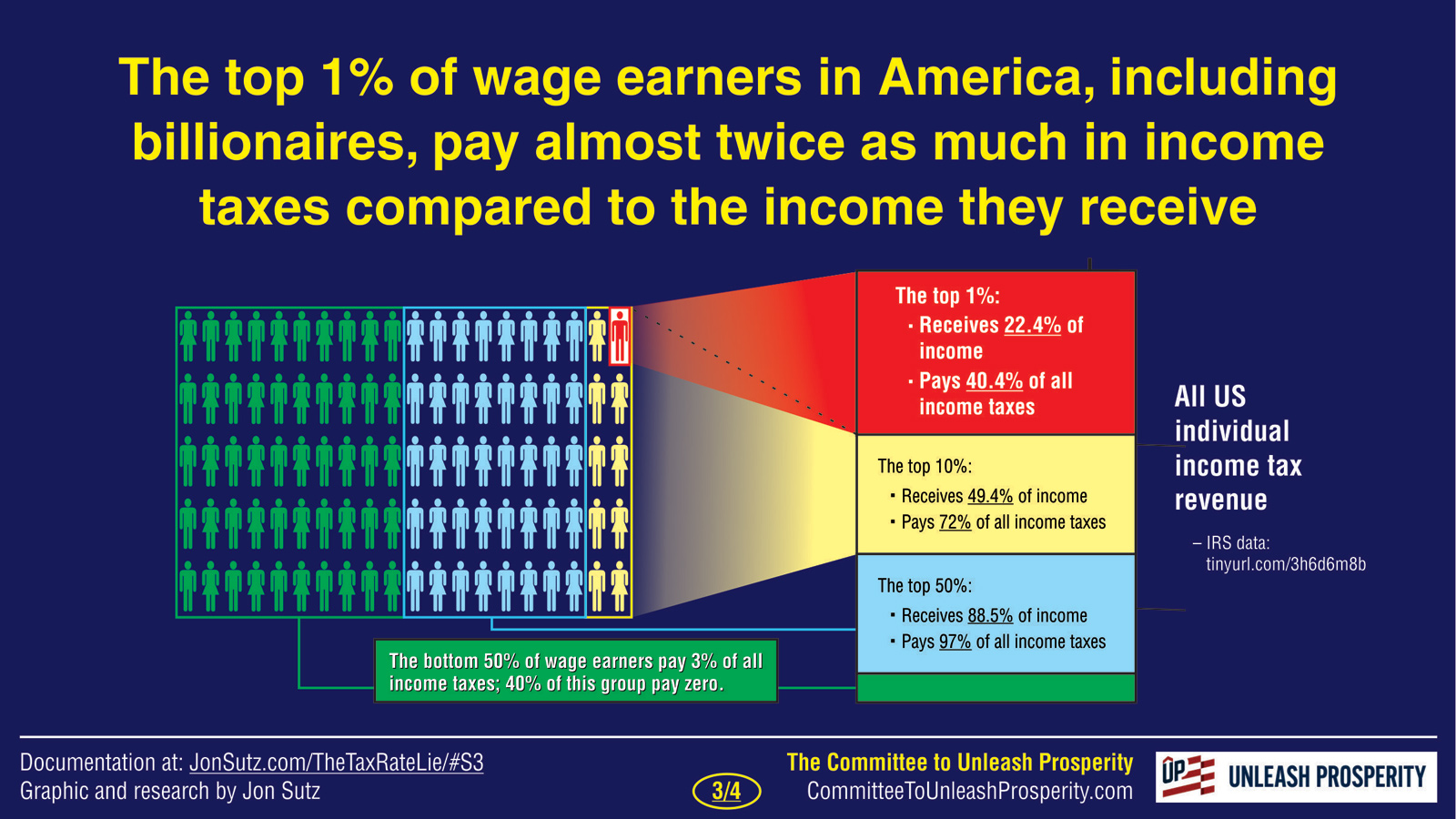
Further, while the top 1% of earners in America take in about 22% of all Adjusted Gross Incomes, they pay more than 40% of income taxes — meaning, they pay nearly twice their share of income to the US Treasury, in income taxes.
Jeff’s payroll taxes: Flat 7.65% rate on his AGI (up to $168,000 total per year) — but must pay an unlimited amount towards Medicare, including a special additional tax on it
On the Payroll Taxes side, the rate that Jeff and others in his tax bracket pay are equal to, or far more than what those in Judy’s tax bracket do:
Social Security: Regardless of how much or little income Jeff earns each year, if he works for an employer, just as in Judy’s case, he must pay 6.2% of his AGI into Social Security, with his employer paying in a matching 6.2% on his behalf. If he’s self-employed he, like the self-employed in Judy’s tax bracket, must also pay another 6.2%, for a total of 12.4%, up to $168,000 total per year. In any case, once he (or Judy) has paid $168,000 into Social Security in a given tax year, they need make no more payments (that year).
Medicare: Just as in Judy’s case, Jeff must pay 1.45% on his AGI, up to $200,000 per year of income. But in Jeff’s case, he must also pay an additional 0.9% surtax on every dollar he earns over $200,000, for a total of 2.35% of his AGI each year, no matter how much money he earns. If his AGI is $100 million in one year, although he’s already paid the maximum $168,000 in Social Security, he must also pay $2,350,000 that year, and each tax year, no matter how much he earns over $200,000, to infinity.
The bottom line, part 1: An apples-to-apples comparison between Judy and Jeff shows that he pays a far higher tax rate than she does
Again, this data is all openly available from the top sources of taxation information: the IRS, the Tax Foundation, the National Taxpayer’s Union, and Reason magazine/the Cato Institute (see Section 6.1 for details). This data is not in dispute.
| Judy | Jeff | |
| Income tax | 12% | 37% |
| Capital gains tax: Short-term | 12% | 40.8% |
| Capital gains tax: Long-term | 0% | 23.8% |
| Dividends tax | 0% | 23.8% |
| Interest tax | 12% | 40.8% |
| Average effective tax rate (income/actual tax payments per year) | 6% | 28% |
| Payroll tax | 7.65% up to $168k in one year | 7.65% up to $168k in one year, but endless Medicare @ 2.35% (including 0.9% surcharge on every dollar he earns over $200,000 per year) |
The bottom line, part 2: An apples-to-apples comparison shows the top 1% of wage earners in America, including billionaires, pay almost twice as much in income taxes compared to the income they receive
See a summary of the IRS source data at “Who Pays Income Taxes?,” a December 2024 report by the National Taxpayers Union. This report shows that the top 1% of wage-earners pay almost twice as much in income taxes compared to the income they earn, while the top 10% pay almost 150% of what they earn, into our Treasury:
| % of total national income received | % of total national income taxes paid | |
| The top 1% | 22.4% | 40.4% |
| The top 10% | 49.4% | 72% |
| The top 50% | 88.5% | 97% |
| The bottom 50% | 11.5% | 3% |
Sources
- Publication 525: Taxable and Nontaxable Income, IRS, September 25, 2025
Lists what counts as taxable income
- SOI Tax Stats — Tax stats at a glance, Internal Revenue Service
An overall depiction of the tax returns submitted from different earner levels and the taxes they paid
- Individual Income Tax Rates and Tax Shares, Internal Revenue Service, November 8, 2025
Official IRS data on who pays what in federal income taxes
- The Distribution of Household Income, 2019, Congressional Budget Office, November 15, 2022
Shows how income is distributed and the taxes households pay across the spectrum
- Capital Gains Taxes: An Overview, Congressional Research Service, April 22, 2020
Explains how capital gains are taxed
- Frequently Asked Questions about the Tax Cuts and Jobs Act [of 2017], Cato at Liberty, June 26, 2024
(4) Due to a lack of simple, cohesive, public-facing push-back — and the tragic state of Americans’ functional literacy — most now believe some variant of this lie

As shown in Section 6.1, various think tanks have produced detailed documentation showing that billionaires pay far higher (a) marginal and (b) effective tax rates than the average American. This report, by the Tax Foundation, provides a crash-course on the clash between the lies that are peddled about this issue, versus the reality:
The Super-Rich Pay Super-Amounts of Taxes, New Treasury Report Finds, Tax Foundation, November 7, 2024
Think tanks, however, tend to think, write and communicate in “think-tank-ese,” meaning, in formats that are informative and persuasive to other think-tankers, and government officials, and academics. Their work products are rich in detail, but only a highly literate and motivated reader can understand them. Further, scholarly content that challenges the lies about billionaires vs. “average Americans'” tax rates typically appears only in conservative media, which only a tiny fraction of Americans consume (example: contrary to popular myth, Fox News only attracts 13% of the US TV news market).
Add in these factors, and it becomes easier to see how so many Americans now believe some version of the billionaire tax lie:
- Between 2000-2014, the average human being’s attention span dropped from 12 to 8 seconds
- 50% of American adults cannot read above an 8th-grade level, and 25% cannot read above a 4th-grade level (functional illiteracy)
- Half the students at 4-year colleges, and 75% at community colleges, cannot perform complex but common literacy tasks, such as understanding the arguments in a newspaper editorial, or comparing the cost-per-ounce of food
- Despite skyrocketing spending on “education,” Americans’ math literacy has steadily fallen:
The bottom line is that virtually zero Americans have ever seen a simple, clear explanation of who pays what tax rates, and what the super-wealthy pay, verses what they do.
I designed this infographics-based investigative report from the ground up to help as many Americans as possible to discover the basic facts about tax rates and revenues to our Treasury, in an efficient, simple and accountable manner.
By the numbers: Most Americans now believe some variant of the lie that billionaires pay lower tax rates than they do, or “don’t pay their fair share”
These metrics are the result of the canyon-sized disconnect between Main St. America and essential facts about tax rates:
59% of Americans think the wealthy don’t pay their fair share of taxes, Gallup, April 8, 2025. Excerpt:
“Republicans are most inclined to believe upper-income people pay their fair share — 48% say this, while 34% think they pay too little. In contrast, 57% of independents and 87% of Democrats think upper-income people pay too little in taxes.” [Averages to 59%]
Americans Who Say Their Taxes Are ‘Fair’ Reaches Near Record Low, Gallup Finds, by Jason Bramwell, CPA Practice Advisor, April 9, 2025
Residents in AOC’s district say how much they think the rich pay in taxes, by Teny Sahakian, Fox News, September 21, 2021. Excerpt:
New Yorkers from Rep. Alexandria Ocasio-Cortez’s district who spoke with Fox News overwhelmingly said the wealthiest people in America pay among the lowest tax rates in the country, which is not supported by data.
“We’re paying too much taxes,” a woman named Lavasquez told Fox News. “The lower and middle classes, we’re working our butts off and we’re paying so much taxes, and then you’ve got the upper class and they’re not paying anything.”
“Its totally unfair,” said Richard, who works in data analytics. “The bottom percentile of individuals are probably paying the bulk of the taxes whereas you have millionaires and billionaires being able to avoid their share.”
The wealthiest people are “definitely paying the bare minimum if any,” he continued. “I would assume it’s about 5%, if that.”
“They should be paying the same amount of taxes as the middle and lower class are,” Lavasquez said. “That way it gives us equal share and no one is feeling singled out.”
60% of Americans say billionaires don’t pay the full amount they owe in taxes, YouGov, April 1, 2022. Excerpt:
A recent YouGov poll, conducted March 31 – April 1, finds that most Americans are skeptical that billionaires in the U.S. pay the full amount of taxes they owe. Three in five (60%) say they don’t generally pay the full amount they owe, while only 22% say they generally do.
Nearly two-thirds of Americans support requiring households to pay at least 20% of their income over $100 million in taxes.
Politicians who have advocated raising taxes on the wealthy, such as Senator Bernie Sanders, have argued that billionaires should not exist. According to our survey, only 32% of Americans agree with this idea.
7 facts about Americans and taxes, Pew Research Center, April 9, 2024. Excerpt:
“A majority of Americans feel that corporations and wealthy people don’t pay their fair share in taxes, according to a Center survey from spring 2023. About six-in-ten U.S. adults say.”
“You fear the man who has a dollar less than you, that dollar is rightfully his, he makes you feel like a moral defrauder. You hate the man who has a dollar more than you, that dollar is rightfully yours, he makes you feel that you are morally defrauded. The man below is a source of your guilt, the man above is a source of your frustration. You do not know what to surrender or demand, when to give and when to grab, what pleasure in life is rightfully yours and what debt is still unpaid to others.”
— Ayn Rand, “Atlas Shrugged”
(5) The most influential peddlers of the lie – and how to contact them
5.1: President Biden
5.2: Sen. Bernie Sanders
5.3: Sen. Elizabeth Warren
5.4: The Washington Post
5.5: CBS News
5.6 Robert Reich
5.7: Center for American Progress
5.8: ProPublica
5.9: Sen. Hillary Clinton
5.10: President Obama
5.11: Rep. Alexandria Ocasio-Cortez
5.1: President Biden
- “There are a thousand billionaires now and you know what their average tax rate is? 8%.” – President Biden, January 25, 2024
- “We have 1,000 billionaires in America. You know what their average tax they pay is? Eight-point-two percent.” – President Biden, August 15, 2024
- “No billionaire should pay a lower tax rate than a teacher, a nurse, or a sanitation worker.” – President Biden, April 16, 2024
Contact information:
- Office of Joe and Jill Biden – Official Contact Form: Contact Form
- Joseph R. Biden Jr. Presidential Library at the National Archives and Records Administration (“NARA”)
Website: bidenlibrary.gov
Mailing Address:
Joseph R. Biden Jr. Presidential Library
National Archives and Records Administration
8601 Adelphi Road, Room 1510
College Park, MD 20740
Email: biden.library@nara.gov
NARA Office Phone: (301) 837‑3250
5.2: Sen. Bernie Sanders
- “Billionaires pay lower tax rate than the middle class.” – Sen. Bernie Sanders on X, September 28, 2020
- “When overwhelming numbers of the American people know that it is beyond absurd that some billionaires and large profitable corporations don’t pay a nickel in federal income tax, maybe just maybe we might want to change our tax system so that the rich and the powerful start paying their fair share of taxes.” – Sen. Bernie Sanders, Business Insider, February 17, 2022
- “True tax rates of billionaires: Warren Buffett: 0.10% Jeff Bezos: 0.98% Michael Bloomberg: 1.30% Elon Musk: 3.27% Tax rate for working class Americans: 24.2%.” – Sen. Bernie Sanders on X, June 8, 2021
- “True tax rate for the 25 richest people in the United States: 3.4%. Average tax rate for a nurse: 24%. A nurse should not pay more in income tax than a billionaire.” – Sen. Bernie Sanders on X, February 7, 2022
- “Jeff Bezos pays a tax rate of 1.1%” – Warren Gunnels, a senior staffer for Sen. Sanders, on X, October 21, 2025. He also claimed, in the same post, that he wants the US government to “tax billionaires out of existence.”
Contact information:
-
Website: sanders.senate.gov
-
Contact Form: Email Senator Sanders
-
Twitter/X: @SenSanders
-
Facebook: Bernie Sanders
- Phone: (202) 224-5141
-
Mailing Address:
Senator Bernie Sanders
332 Dirksen Senate Office Building
Washington, DC 20510
5.3: Sen. Elizabeth Warren
- “Jeff Bezos gets enough tax loopholes that he pays at a lower rate than a public school teacher.” – Sen. Elizabeth Warren, March 19, 2024
- “I want these billionaires to stop being freeloaders… [and to] pick up their fair share.” – Sen. Elizabeth Warren, CNBC, January 19, 2019
Contact information:
-
Website: warren.senate.gov
-
Contact Form: Email Senator Warren
-
Twitter/X: @SenWarren
-
Facebook: Elizabeth Warren
- Phone: (202) 224-4543
-
Mailing Address:
Senator Elizabeth Warren
309 Hart Senate Office Building
Washington, DC 20510
5.4: The Washington Post
- Headline: For the first time in history, U.S. billionaires paid a lower tax rate than the working class.” – Washington Post, October 8, 2019
Contact information:
-
Website: washingtonpost.com
-
Newsroom / Tips: Newsroom Contact
-
Twitter/X: @washingtonpost
-
Main Phone: (202) 334-6000
-
Mailing Address:
The Washington Post
1301 K Street NW
Washington, DC 20071
5.5: CBS News
- Headline: “Billionaires pay a lower tax rate than the rest of America’s taxpayers, new study finds.” – CBS News, August 27, 2025
Contact information:
-
Website: cbsnews.com
-
Contact Page: CBS News Feedback
-
Twitter/X: @CBSNews
-
Facebook: CBS News
- Main Phone: (212) 975-4321
-
Mailing Address:
CBS News
530 W 57th Street
New York, NY 10019
5.6 Robert Reich
- “Billionaires are paying a lower tax rate than the average American.” – Robert Reich (UC-Berkeley professor of economics), October 2, 2022
Contact information:
-
Website: RobertReich.org
-
Twitter/X: @RBReich
-
Facebook: Robert Reich
-
Instagram: @RBReich
-
Mailing Address:
Robert Reich
c/o Goldman School of Public Policy
University of California, Berkeley
2607 Hearst Ave, Berkeley, CA 94720
Also, regarding Reich’s (taxpayer-funded) employer, the UC-Berkeley Department of Economics:
-
Website: econ.berkeley.edu
-
Contact: Contact Page
-
Phone: (510) 642-0822
-
Mailing Address:
UC Berkeley Department of Economics
530 Evans Hall #3880
Berkeley, CA 94720-3880
5.7: Center for American Progress
- The Ultra-Rich Have Lower Tax Rates, – University of California-Berkeley Research, September 4, 2025
Contact information:
-
Website: americanprogress.org
-
Contact Page: Contact CAP
-
Twitter/X: @amprog
-
Facebook: Center for American Progress
- Phone: (202) 682-1611
-
Mailing Address:
Center for American Progress
1333 H Street NW, 10th Floor
Washington, DC 20005
5.8: ProPublica
- The Secret IRS Files: Trove of Never-Before-Seen Records Reveal How the Wealthiest Avoid Income Tax, – ProPublica, June 8, 2021. (Note: This “report,” has been repeatedly debunked [1, 2, 3, 4], and was based on the felonious disclosure of taxpayer returns to ProPublica. The perpetrator pleaded guilty, and was sentenced to five years in prison.)
Contact information:
-
Website: propublica.org
-
General Inquiries Email: info@propublica.org
-
Corrections Email: corrections@propublica.org
-
Mailing Address:
155 Avenue of the Americas, 13th Floor
New York, NY 10013 -
NYC Office Phone: (212) 514‑5250
-
Midwest Office Phone: (708) 967‑5720
Social Media:
(5.9) Sen. Hillary Clinton
- “A Wall Street money manager should not be able to pay a lower tax rate than a teacher or a nurse… we’re going to make the super-rich start paying their fair share.” – Sen. Hillary Clinton, October 3, 2016
Contact information:
-
Website: HillaryClinton.com
-
General Inquiries Email: None listed
-
Corrections Email: None listed
-
Mailing Address:
Hillary Rodham Clinton
Post Office Box 5256
New York, NY 10185 -
NYC Office Phone: None listed
-
Midwest Office Phone: None listed
Social Media:
(10) President Obama
- “Right now, Warren Buffett pays a lower tax rate than his secretary.” – President Obama, State of the Union speech, January 24, 2012
Contact information:
-
Website: BarackObama.com
-
General Inquiries Email: info@barackobama.com
-
Corrections Email: None listed
- Contact Page: Here
-
Mailing Address:
Office of Barack and Michelle Obama
P.O. Box 91000
Washington, DC 20066 -
Washington, DC Office Phone: 202-464-6903
Social Media:
(11) Rep. Alexandria Ocasio-Cortez
- “It’s ludicrous that we tax Warren Buffet’s secretary more than we tax him.” – Rep. Alexandria Ocasio-Cortez, December 4, 2018
Contact information:
-
Website: Ocasio-Cortez.House.gov
-
General Inquiries Email: ocasio-cortez.house.gov/contact
-
Corrections Email: None listed
- Contact Page: Here
-
Mailing Address:
Rep. Alexandria Ocasio-Cortez
250 Cannon HOB
Washington, DC 20515 -
Washington, DC Office Phone: 202-225-3965
Social Media:
(6) The source data
6.1: A sampling of the debunkings of these lies
6.2: The 2017 Tax Cuts & Jobs Act reduced the tax rate of millions of low-income Americans to 0% – or less
6.1: A sampling of the debunkings of these lies
The Super-Rich Pay Super-Amounts of Taxes, New Treasury Report Finds, Tax Foundation, November 7, 2024
Do Billionaires Really Pay No Taxes?, by Phillip W. Magness, USAFacts, July 1, 2025
ProPublica’s Bombshell Tax Report That Wasn’t, Reason, June 9, 2021
Do the Rich Pay Their Fair Share of Taxes?, Tax Foundation, March 25, 2021
Outrage over billionaires’ tax returns ignores basic facts, Jonah Goldberg, Herald-Standard (Uniontown, PA), June 17, 2021
Biden Continues to Make Misleading Tax Rate Claim, TaxNotes, August 16, 2024
The ‘Billionaire Tax Rate’ Is Not 8.2 Percent: A viral claim relies on a misleading definition of income, by Alex Demas, The Dispatch, March 25, 2024
Biden’s Twitter account fact-checked for dubious claim about the taxes billionaires pay, by Andrea Vacchiano, Fox News, March 19, 2023
President Joe Biden distorts income tax rates for the richest Americans, by Sophia Voight, PolitiFact, January 26, 2024
Fact-Check: Taxes on the Rich, Cato Institute, March 7, 2024
Who Is Paying Their Fair Share of Taxes? A New Analysis and Interactive Tool, The Budget Lab, September 30, 2024
PolitiFact | Kamala Harris off base on tax rate comparison of billionaires, teachers, by Louis Jacobson, PolitiFact, October 10, 2024
Who Pays Income Taxes?, National Taxpayers Union, December 2024
6.2: The 2017 Tax Cuts & Jobs Act reduced the tax rate of millions of low-income Americans to 0% – or less
One of the signature legislative items President Trump wanted to achieve in his first term (2017-2021) was to get Congress to pass a tax reform bill that he claimed would help to spur economic growth, and lower the tax burden on the lowest-income Americans. Titled “The Tax Cuts and Jobs Act,” it was passed into law in December 2017, and took effect in 2018.
Although the media and Democrats insisted the bill would not do what it promised, in fact it did take millions of low-income American workers off the tax rolls altogether, and even provided many with cash “refunds.”
From the report, Fact-Check: Taxes on the Rich, Cato Institute, March 7, 2024:
“Average tax rates on the low- and middle-income quintiles have trended downward. Households in the low quintile pay no net federal taxes, while households in the middle quintile paid about 13 percent in recent years prior to 2020. Tax rates plunged in 2020 due to “recovery rebate credits” handed out that year, which were refundable tax credits.
“In sum, Treasury and CBO data show that federal tax rates at the bottom average about 0 percent or less, tax rates in the middle average less than 15 percent, and rates at the top average around 30 percent. Average tax rates at the top are twice the tax rates in the middle.”
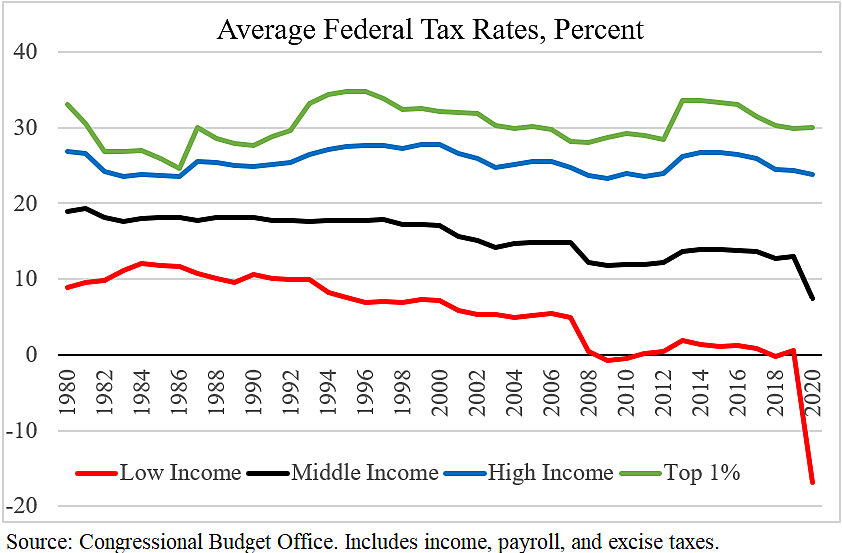
Read more at: Frequently Asked Questions about the Tax Cuts and Jobs Act, Cato at Liberty, June 26, 2024
6.3: Links to key IRS and government agency pages containing the source data that debunks this lie
General data: Who pays what in taxes
- Publication 525: Taxable and Nontaxable Income, IRS, September 25, 2025
Lists what counts as taxable income
- SOI Tax Stats — Tax stats at a glance, Internal Revenue Service
An overall depiction of the tax returns submitted from different earner levels and the taxes they paid
- Individual Income Tax Rates and Tax Shares, Internal Revenue Service, November 8, 2025
Official IRS data on who pays what in federal income taxes - Frequently Asked Questions about the Tax Cuts and Jobs Act, Cato at Liberty, June 26, 2024
- The Distribution of Household Income, 2019, Congressional Budget Office, November 15, 2022
Shows how income is distributed and the taxes households pay across the spectrum - Capital Gains Taxes: An Overview, Congressional Research Service, April 22, 2020
Explains how capital gains are taxed
- The Distribution of Household Income, 2019, Congressional Budget Office, November 15, 2022
Shows how income is distributed and the taxes households pay across the spectrum
- Publication 1304: Individual Income Tax Returns — Complete Report (2022), IRS, Revised 2025
Detailed breakdown of income, deductions, and federal tax payments
- SOI Tax Stats – Individual Income Tax Rates and Tax Shares, IRS, November 8, 2025
Shows tax contributions by percentile of income
Taxes on capital gains and investment income
- Capital Gains Taxes: An Overview, Congressional Research Service, April 22, 2020
Explains how capital gains are taxed
- Topic No. 409 – Capital Gains and Losses, IRS, September 2, 2025
IRS guide on capital gains taxation
- Topic No. 404 – Investment Income, IRS, September 2, 2025
IRS guide on interest, dividends, and investment income
- IRS Revenue Procedure 2024-40: 2025 Tax Inflation Adjustments Official IRS document detailing inflation-adjusted tax brackets, standard deduction ($15,000 for single filers), and long-term capital gains thresholds for 2025
- Internal Revenue Code §1(h): Maximum Capital Gains Rate Establishes the preferential 0%/15%/20% long-term capital gains rate structure (unchanged for 2025, with inflation-adjusted thresholds)
- IRS Form 1040 Instructions and Schedule D (Capital Gains and Losses) for 2025
Provides guidance on reporting capital gains, confirming short-term gains are taxed at ordinary income rates (10%–37%) and including worksheets for calculations
- Internal Revenue Code §1411: Net Investment Income Tax
Imposes the 3.8% surtax on investment income (including capital gains) for single filers with modified AGI over $200,000
(7) Responses from the peddlers of this lie
In this section, I will publish any responses that influential peddlers of this lie, starting with those in Section 5., post in response to challenges to the billionaires-tax rate lie.
I hope my infographics in Section 3 will be helpful in compelling them to either (a) admit that they knowingly or unknowingly spread this lie, and are sorry, or, (b) keep digging into this lie, thus exposing them for who and what they truly are.
(8) Afterword: My view on the urgent need to use evidence-based means to combat the lies that are ripping America apart

“If men are to be precluded from offering their sentiments on a matter, which may involve the most serious and alarming consequences, that can invite the consideration of mankind, reason is of no use to us; the freedom of speech may be taken away, and, dumb and silent we may be led, like sheep, to the slaughter.”
–– George Washington, address to the officers of the Army, March 15, 1783
The ability of America to survive as a free, prosperous, self-governing, socially-cohesive self-governing republic depends on citizens having access to accurate, verifiable and timely information about the most important and controversial issues facing us. Whenever anyone with influence begins deliberately inserting falsehoods into our public consciousness about such issues, it is the obligation of honest, patriotic people and organizations to challenge these falsehoods, in a way that the broad American “family” can see and understand — including the young.
The genesis of my motivation to submit my proposal to the Committee to Unleash Prosperity to create the infographics on this page was my extreme frustration, based on my observations described in Section 4, that this egregious lie, about the US tax system being so corrupt that poor people subsidize billionaires, keeps spreading, like a virus through a living organism that has a malfunctioning immune system.
As a result, average, everyday Americans are being pitted against each other, like dogs, over this lie — and to my knowledge, there was no resource that an average, ordinary, reasonable American adult — or adolescent — could see, and find persuasive.
I decided that the time is long overdue to publicly drive a metaphorical stake through the heart of this lie, once and for all, in so simple a way that even a functional 12-year-old, with zero knowledge of (or interest in) taxation, can (a) easily understand and verify, and (b) use to challenge anyone who peddles this lie.
This page is the result of my effort. If you find it of value, I hope you will share it, or at least some of the infographics on it, with others who you think might be willing to check what they think they know about our tax system, and who pays what, against the evidence on this page.
Jon Sutz, March 8, 2026